
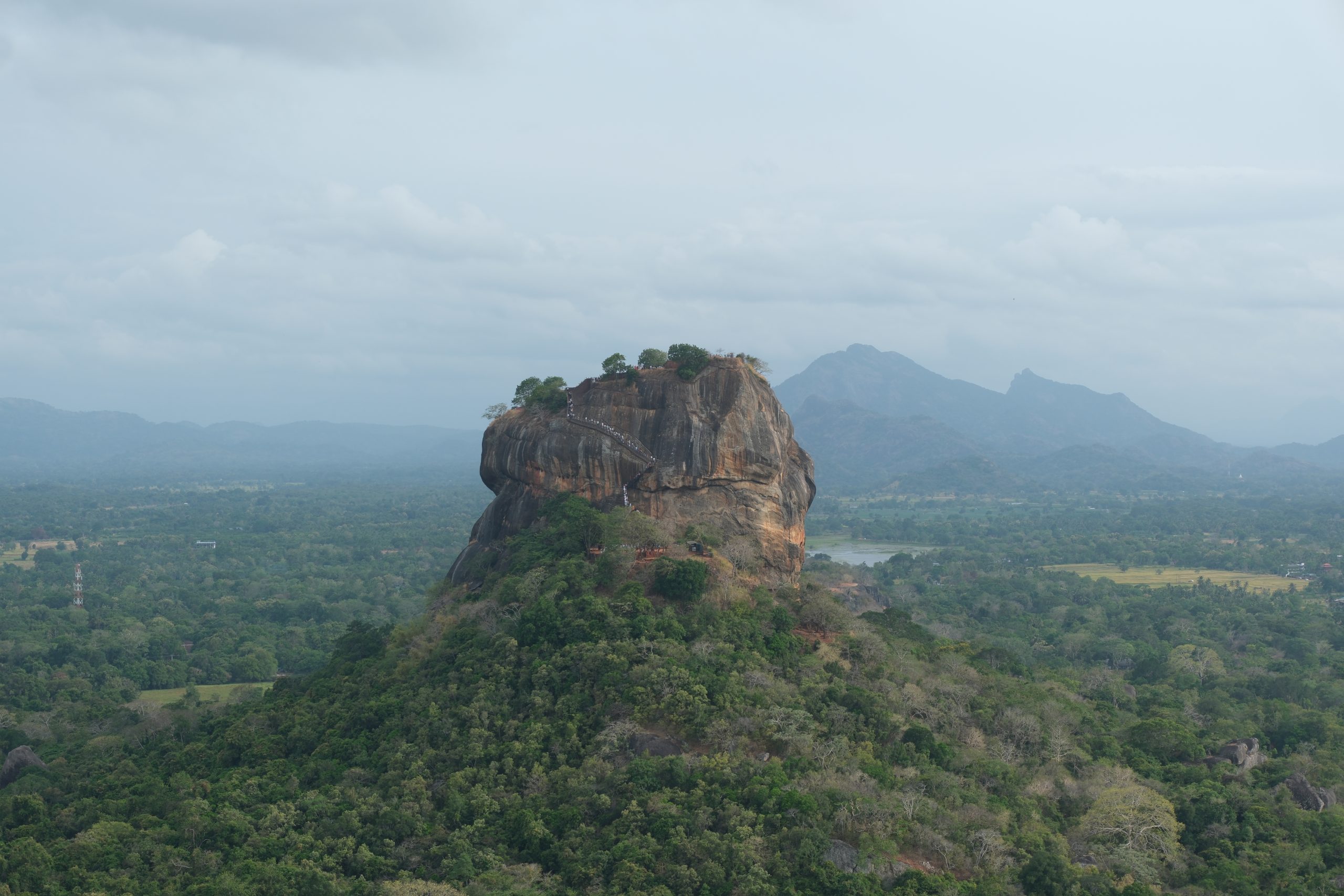
Lion Rock does not so much rise from the plains of Sri Lanka’s Cultural Triangle as refuse to be part of them, a 200-metre column of stone that seems to have decided, centuries ago, that it belonged to the sky rather than the earth. Near its top, a king once built a palace equal to his own ambition, and the rock has never quite let go of the memory. Yet you should climb it all the same, past maidens painted in ochre and giant lion’s paws worn soft by time. At the summit, the ruins open onto a panorama so vast and still it feels less like looking at a view and more like unfolding a very old map of the world. In the rock’s shadow, you will find a village learning slowly how to hold its own beside such a monument. Eco-resorts now thread through the paddy fields and forests that hem the old guesthouses, and beyond them, wild elephants still move across the shallows of Minneriya as if none of this was new. When you have had enough of looking up, there is always Pidurangala, waiting to let you look down.


What to see & do
Rising from the central plains like a natural fortress, Sigiriya is one of Sri Lanka’s most extraordinary destinations — part ancient royal citadel, part archaeological mystery. Beyond the rock itself, the surrounding region is dense with cave temples, medieval cities and wildlife-rich wetlands.
Sigiriya Rock Fortress
A UNESCO World Heritage Site and one of Sri Lanka’s most remarkable archaeological treasures, Sigiriya was transformed into a royal citadel by King Kashyapa in the 5th century, who built one of the ancient world’s most audacious palaces atop the rock. Though his reign ended in tragedy, the ruins still speak of extraordinary ambition. The climb to the summit is steep but manageable via paved pathways — allow around an hour — culminating between enormous lion’s paws, remnants of a colossal sculpture that once guarded the palace entrance, before a final staircase clings to the rock face. What awaits is not a preserved palace but its outline: masonry foundations, terraced platforms and rock-cut reservoirs tracing the original layout. On the descent, do not miss the frescoes, a handful of figures painted directly onto the rock face over 1,500 years ago, preserved today in sheltered alcoves high above the plains.

Pidurangala Rock
Just a five-minute tuk-tuk ride from Sigiriya, Pidurangala Rock offers one of the finest viewpoints in the region. Far less crowded than its famous neighbour, the climb is shorter and more relaxed, though it still involves steep steps and a brief boulder scramble near the summit — sturdy footwear is recommended. The reward is a sweeping panorama across the central plains and, most importantly, an unobstructed view of Sigiriya itself, its silhouette especially striking at sunrise or sunset.
Dambulla Cave Temples
A short drive from Sigiriya, the Dambulla Cave Temple offers a fascinating glimpse into Sri Lanka’s Buddhist heritage. Built within a vast rock outcrop, the complex comprises five cave shrines filled with more than 150 Buddha statues and richly coloured murals blanketing the walls and ceilings. Dimly lit and scented with incense, it houses some of Sri Lanka’s most important religious artwork.

The Ancient City of Polonnaruwa
About an hour’s drive from Sigiriya, Polonnaruwa is a UNESCO World Heritage Site and one of Sri Lanka’s great medieval capitals. Serving as the island’s royal seat between the 11th and 13th centuries, it remains remarkably well preserved. Start at the Quadrangle, a compact collection of religious monuments centred around the Vatadage, an intricately carved circular relic house once believed to have housed the Buddha’s sacred tooth. Other highlights include the Lankatilaka shrine, where towering walls still rise around a headless Buddha statue beneath an open sky, and the Gal Vihara, whose four colossal Buddha figures are carved directly into a single granite outcrop.
Minneriya Elephant Safari
A visit to Sigiriya also provides easy access to one of Sri Lanka’s most memorable wildlife experiences: an elephant safari in Minneriya National Park. During the dry season, the park witnesses one of the largest concentrations of wild Asian elephants in the world. Known as “The Gathering”, this seasonal phenomenon usually peaks in August and September, when herds are drawn to the reservoir to drink, bathe and graze on fresh grass. Alongside deer, monkeys and a wide variety of birdlife, a safari offers the chance to observe these magnificent animals in their natural habitat. While the park opens early, the late afternoon hours generally provide the best wildlife viewing, when cooler temperatures encourage animals to gather around the water.

Where to stay
Sigiriya’s accommodation scene has grown fast, but standards vary and prices can feel high for what is on offer. For a more luxurious stay, look to the boutique hotels and eco-resorts scattered through the surrounding countryside set among forests, paddies and lakes, with pools, spas and strong on-site dining. Exact location matters less here than elsewhere: Sigiriya itself is a small village with little beyond the rock, and the region’s sites are spread well apart, so comfort is the better guide.
Jetwing Vil Uyana
One of the region’s most distinctive luxury stays, Jetwing Vil Uyana is built around a network of lakes, wetlands and paddy fields designed to recreate Sri Lanka’s natural landscapes. Spacious villas are scattered throughout the property, offering a high degree of privacy alongside thoughtful design and attentive service. The resort is particularly appealing for nature lovers, with frequent sightings of birds, monkeys and other wildlife throughout the grounds. Facilities include a spa, swimming pool and several excellent dining options, while Sigiriya Rock is just a short drive away.
Heritance Kandalama
Sri Lanka’s most celebrated modernist hotel, Heritance Kandalama was designed by Geoffrey Bawa and built directly into a mountainside — a five-star architectural landmark with sweeping views over jungle and lake. Rooms are spacious and understated, featuring timber accents, rattan furnishings and large windows that flood the interiors with natural light. Infinity pools appear to merge with the jungle beyond, while several restaurants and bars take full advantage of the hotel’s dramatic setting. Facilities include a spa, gym and tennis courts, and sustainability is woven into the design rather than added as an afterthought.
Taru Villas Maia
On the edge of Habarana, set among forests, paddy fields and plantations, Taru Villas Maia offers a peaceful boutique retreat within easy reach of Sigiriya Rock and the Cultural Triangle’s major attractions. Exposed brickwork, natural materials and understated interiors give the property a warm, contemporary character, while a small collection of rooms and chalets creates an intimate atmosphere. An infinity pool, open-air dining pavilion and wellness facilities encourage guests to slow down between excursions, and its location makes it a particularly convenient base for elephant safaris, with Minneriya National Park just a short drive away.
Where to eat
Despite its growing popularity, Sigiriya’s dining scene remains small, reflecting the village’s size and rural setting. Family-run restaurants and cafés are plentiful, with most menus centred on Sri Lankan favourites alongside a selection of familiar Western dishes. Many of the best experiences are found within boutique hotels, where restaurants make the most of their scenic surroundings.
Apsara
The signature restaurant at Jetwing Vil Uyana occupies an open-air pavilion overlooking the resort’s lake, with Sigiriya Rock visible in the distance. Sri Lankan, Asian and Western influences come together here, with a strong emphasis on locally sourced ingredients that reflect the property’s sustainability ethos. Offerings change seasonally, but the standout is the seafood platter — Mahi Mahi fillet, yellowfin tuna, tiger prawn and lagoon black prawn, served with sticky lemon coconut rice and a citrus tomato salsa. For something more memorable, Vil Uyana also offers signature dining experiences in a treehouse or on a quiet hill.
King’s Pavilion
At King’s Resort, refined Sri Lankan and international cuisine is served in one of the area’s most scenic dining settings. For the best experience, choose a table on the terrace, where views stretch across Halmilla Lake towards Sigiriya Rock. The highlight is the rice and curry — a generous Sri Lankan spread that showcases a wide range of flavours and offers one of the most satisfying introductions to local cuisine in the area.
Nagula
Set on the veranda of Aliya Resort & Spa’s Paddy Museum in Sigiriya, Nagula offers a rustic setting overlooking the resort’s paddy fields and surrounding rice terraces. The focus is purely Sri Lankan cuisine, made from ingredients grown on-site or sourced locally. The standout is the theatre of it all — meals cooked in clay pots on clay stoves, recreating an old-style Sri Lankan kitchen, alongside a display of antique agricultural tools once used for paddy harvesting.
Soul Food Café
Set on the edge of a lake with views of Sigiriya Rock, the setting is one of its strongest draws. The menu is fully vegetarian and vegan, ranging from avocado toast and burgers to wraps and all-day brunch served from morning into the evening, with a wood-fired oven producing freshly made pizzas later in the day. It is a popular spot, and during busy periods service can be slow, so allow extra time.

