
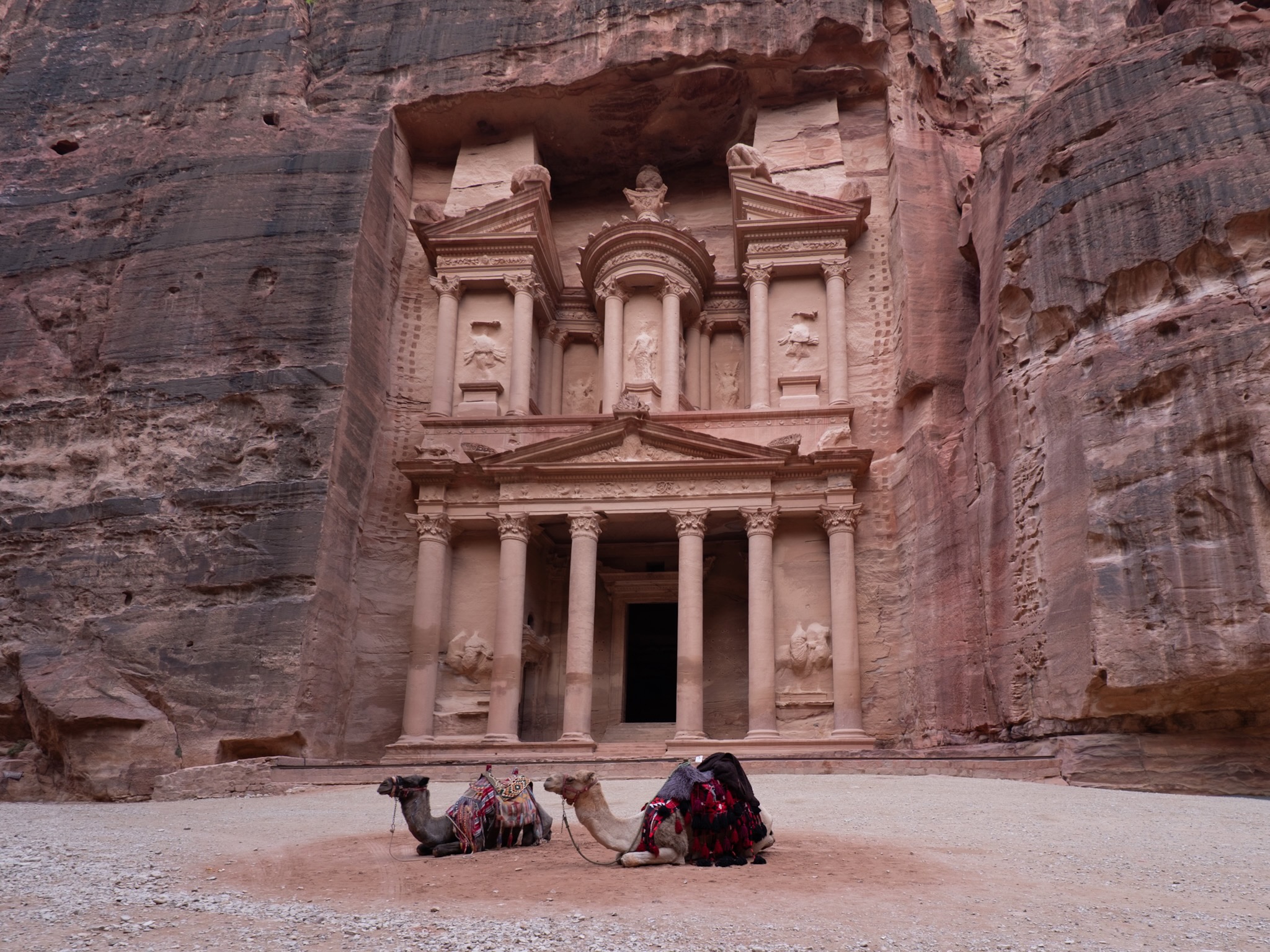
Some places in the world reveal themselves gradually, teasing discovery around each turn. Petra is not one of them. As you walk through the Siq, a narrow gorge that serves as the ancient city’s dramatic entrance, its soaring sandstone walls come alive in the soft morning light. The silence is so complete that your own footsteps sound like an intrusion, the weight of history pressing down as you hurry forward in anticipation. Then the gorge widens, and there it is: the Treasury, rising from the rose-red rock in one of the most jaw-dropping encounters the ancient world has to offer.
Yet Petra is far more than a single façade. Over two millennia ago, the Nabataeans carved an entire city directly into the cliffs—temples, tombs, and collonaded streets cut from solid rock—before the Romans conquered the kingdom in 106 AC. More than 600 façades remain today. It all endures, so monumentally and so defiantly, in the middle of the Jordanian desert, a testament to one of history’s most remarkable civilisations.


What to see & do
Walk the Siq and marvel at The Treasury
The narrow, high-walled gorge known as the Siq delivers you to Petra’s most iconic façade: Al-Khazneh, the Treasury, the image most people picture when they think of Petra. Carved directly into sandstone in the 1st century BC, it stands 40 metres tall and is thought to have served as a mausoleum for the Nabataean King Aretas IV. Its name comes from a Bedouin legend that an Egyptian pharaoh hid treasure inside the urn crowning its façade — locals reportedly fired bullets at it to release it, explaining the pockmarks visible today. In truth, the interior is a single, bare room, and archaeologists still debate its original purpose. None of that diminishes the sheer drama of this monumental façade emerging suddenly before you.
Colonnade Street and the Great Temple
Petra’s main civic boulevard once ran straight through the heart of the city, lined with columns and flanked by shops, markets and public buildings. At its peak, it was home to an estimated 20,000–30,000 inhabitants. Built in the 1 century BC, following the Roman annexation, it replaced an earlier Nabataean street and marks the city’s transformation into a Roman province. At its southern end stands the Great Temple, one of Petra’s largest complexes, originally built by the Nabateans later remodelled by the Romans. Despite its name, archaeologists still debate whether it served a religious or civic purpose. Its vast courtyard, monumental stairways and colonnaded hall, plus a small theatre-like space for gatherings, speak to just how sophisticated life here once was.
The Roman Theatre
Carved directly into the rose-red rock face, Petra’s Roman Theatre is one of the city’s most dramatic feats of engineering. Built by the Nabataeans in the 1st century AD and later expanded by the Romans, it could seat up to 8,500 people. Facing the colonnaded street below, it sits at the very heart of ancient Petra, a reminder that this was a place of culture and ceremony, not just trade.


The High Place of Sacrifice
The climb to al-Madhbah, the High Place of Sacrifice, is an act of commitment. The path winds upward for around 40 minutes, past two towering obelisks carved not from stone brought to the mountain but from the mountain itself, their iron-rich flanks catching the desert light. At the summit, the Nabataeans honoured their god Dushara with offerings, libations and, almost certainly, blood sacrifice. Whether the rites ever turned to humans remains conjecture, but the platform’s scale leaves little doubt this was the city’s foremost place of worship. Descend via Wadi Farasa: a lion carved into the cliff, a Garden Triclinium once used for funerary feasts, and the columned Roman Soldier Tomb make the long way down a journey in its own right.
Explore the Royal Tombs
The Royal Tombs, four grand façades—the Urn, Silk, Corinthian and Palace Tombs— are carved into a single imposing row. The Urn Tomb is believed to have been built for King Malchus II or Aretas IV in the 1st century AD, and later converted into a Byzantine cathedral in the 5th century. Then there is the Palace Tomb, named for its resemblance to a Roman palace though there is no evidence it was a royal residence. At 49 metres wide and 46 metres tall, it is one of Petra’s largest monuments — and one of the only ones where the Nabataeans, running out of rock face, kept building upwards with stone blocks. Time it for late afternoon, when the light turns the rock a deep, burnished amber.
Climb to the Monastery
After the Treasury, some travellers think they have immediately seen the best of Petra. Do not make this mistake; the Treasury is only the opening act. Those who make the climb to Ad-Deir, the Monastery, will find something that arguably surpasses even the Treasury. Older, broader and taller, it predates the Treasury by some two centuries. Where the Treasury stuns through elegance, the Monastery overwhelms through sheer mass. Built in the 3rd century BC as a royal tomb, it was later converted into a Christian church during the Byzantine period, with the crosses carved into its inner walls still visible today. The cliffs in front of the Monastery offer some of the finest views in Petra.

Where to stay
Petra archaeological park is served by Wadi Musa. The town is largely functional, developed around one extraordinary attraction. Therefore, the best piece of advice for a Petra stay is to book as close to the park entrance as you can. The walk from the gate through the Siq is long, and after eight hours on foot, the uphill return will test even the most enthusiastic traveller. At the end of the day, a hotel right across the street becomes a lifeline. Proximity has another payoff too: an earlier start, well ahead of the day-trippers bussed in from Amman, and a few precious moments of cooler, quieter sightseeing before the crowds descend.
Another consideration when choosing accommodation is the breakfast offering. Kitchens open before the park to allow early starts and the spreads are generous, true to Jordanian form. Many hotels also offer packed lunches, which is worth taking advantage of, as food options inside the park are limited, and a good packed lunch will serve you far better on the trails.
Mövenpick Resort Petra
Steps away from the entrance gate is the five-star Mövenpick Resort Petra, the most convenient luxury option in the area. Its architecture nods to local design without leaning into pastiche, and the property earns its rating with mountain views, lush gardens, a spa, and multiple dining options including a rooftop terrace. For those who want to be first through the gate in the morning and last out in the evening, the location alone justifies the price.
Crowne Plaza by IHG
Reopened in 2026 following a major renovation, the Crowne Plaza Resort Petra has returned in strong form. The rooms, chalets, and public spaces have been refreshed with a clean, contemporary feel. Amenities include a pool, gym, multiple dining venues and Mountain Views over the Sharrah Mountains. The real draw, though, is the unbeatable location. Steps from the entrance gate, the ancient city is essentially on the doorstep.
Petra Guest House Hotel
Arguably the best-located hotel in Petra, the Petra Guest House literally sits steps from the entrance gate. Accommodation ranges from spacious chalets to smaller rooms in the main building. Rooms are spacious, traditionally furnished, well-equipped, and offer mountain views.
Petra Moon Luxury Hotel
A five-minute walk from the visitor centre, the Petra Moon Luxury Hotel delivers good value at its price point. Rooms are spacious with mountain views, a rooftop pool for tired legs at the end of the day, and a generous breakfast served early enough for those wanting to beat the crowds to the gate.

Where to eat
In Wadi Musa, some of the best dining is found inside hotel kitchens, making your choice of where to stay more important if a memorable meal matters to you. In town, expect mostly straightforward restaurants with menus unpretentious Jordanian staples, from mezze and grilled meats to the ever-present mansaf – Jordan’s national dish.
Jordan Heritage
Jordan Heritage is housed in a castle-like building in the heart of Wadi Musa. The menu draws on traditional recipes from across the country, each with its own history and sense of place. There is plenty to choose from, but one dish is impossible to overlook: Mansaf. Here, lamb is slow-cooked until meltingly tender, layered over fragrant saffron rice and drenched in the rich, tangy jameed sauce, then finished with toasted almonds and fresh herbs.
My Mom’s Restaurant
Perfect for visitors seeking authentic, unpretentious Jordanian comfort food. The menu leans into Jordanian classics: Mansaf, Maqluba, grilled meats, kofta, and fresh mezze, portioned with the kind of generosity that characterises Jordanian restaurants. Decorated in a warm Bedouin style, the rooftop terrace is the spot to aim for an al fresco meal, a drink, or a lazy shisha under the evening sky.
Old Street Cafe
Conveniently placed just a two-minute walk from Petra’s entrance, Old Street Cafe is a natural stop for hungry travellers at the end of a long day on the trails. The menu celebrates the Jordanian classics. The more adventurous diners can sample camel meat, a Bedouin staple with deep roots in the region’s desert traditions. The atmosphere is informal, portions are hearty, and prices are reasonable for the location.
Where to drink
The Cave Bar
There are not many places in the world where you can order a cocktail inside a 2,000-year-old tomb, but Petra is not like anywhere else. Touted as the oldest bar location in the world, the Cave Bar is carved directly into the rock, steps from the main gate. Hazily lit, with armchairs tucked into ancient stone alcoves and a grand open space for warmer evenings. The menu spans local Jordanian beer, arak (the Levant’s anise-spiked spirit), wine, cocktails, and non-alcoholic options, a welcome range in a country where alcohol can otherwise be surprisingly elusive.
