
Delhi does not introduce itself gently. The city arrives in a rush of sound and spice, of tuk tuks weaving through narrow lanes and cardamom-scented chai steaming on roadside carts. It is not a city that tries to charm you; it confronts and surrounds you. It is not quiet, predictable or neatly ordered. Instead it is layered, chaotic yet poetic, exhausting yet exhilarating, a place where sensory overload is simply part of daily life.
Dynasties have risen and fallen here, from the Delhi Sultanate to the Mughals and the British Raj, leaving behind a tapestry of forts, mosques, gardens and grand boulevards. In Old Delhi, spice merchants still measure out fragrant powders in centuries-old bazaars. While cycle rickshaws weave through alleys lined with fading havelis, temples and markets thick with movement. Around every corner the air carries something different — incense, frying snacks or the sharp tang of spices. Across town, New Delhi reveals another rhythm: colonial symmetry, broad avenues, quiet diplomatic enclaves, and elegant Lutyens-era architecture. The contrast between the two halves of the capital tells much of the city’s story.


What to see and do
The Red Fort
Mughal Emperor Shah Jahan commissioned The Red Fort in the mid-17th century. This vast red sandstone fortress served as the main residence of the Mughal rulers for nearly 200 years until 1857. The complex features palaces, audience halls and gardens with defensive walls stretching over two kilometers. Today, the UNESCO-listed monument stands as one of Delhi’s most significant historical landmarks.
Humayun’s Tomb
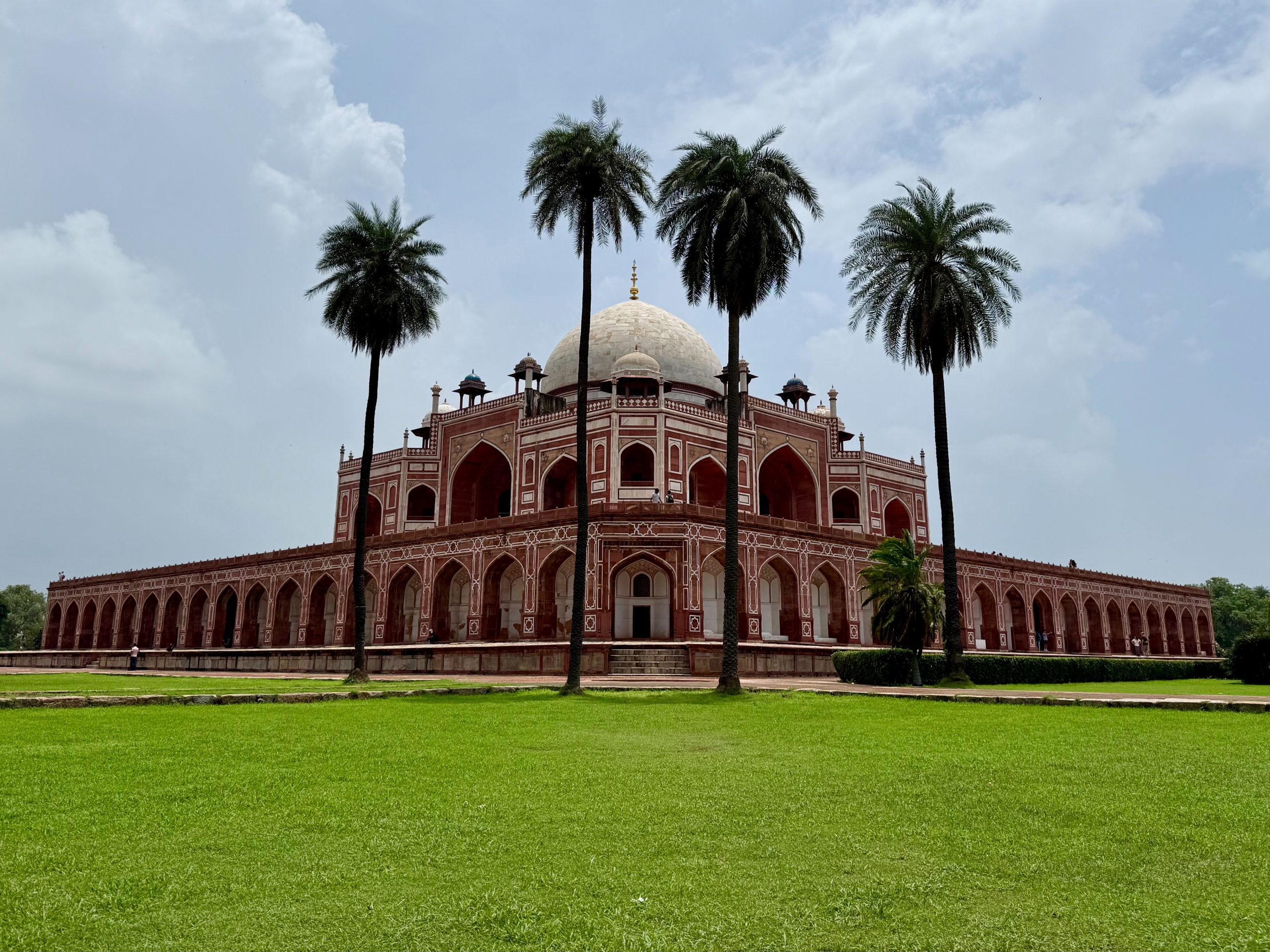
Built in 1570, this grand Mughal mausoleum was commissioned by Empress Bega Begum in memory of Emperor Humayun. Designed in a Persian-influenced style, the red sandstone and white marble structure sits within a formal charbagh garden with a geometrically planned layout divided by water channels. It is recognised as a UNESCO World Heritage Site and is considered a precursor to the Taj Mahal.
India Gate
India Gate is a war memorial in the heart of New Delhi, designed by British architect Edwin Lutyens and completed in 1931. It honours more than 70,000 Indian soldiers of the British Indian Army who died in World War I and the Third Anglo-Afghan War. It stands 42 metres above the lush lawns and boulevards of central Delhi.
Qutub Minar
Rising 73 metres above southern Delhi, construction on this red sandstone minaret and victory tower began in 1199 by Qutb-ud-din Aibak. It was later expanded by his successors in the Delhi Sultanate and is an early example of Indo-Islamic architecture. As India’s tallest tower, its five tapering storeys are separated by balconies and decorated with carved calligraphy. It stands within an extensive UNESCO World Heritage site that houses the Quwwat-ul-Islam Mosque, gateways, courtyards and other important monuments from Delhi’s early Islamic history.
Lotus Temple
Shaped like a blooming lotus, the Bahá’í House of Worship in Delhi was completed in 1986 and designed by Iranian-Canadian architect Fariborz Sahba. The structure consists of 27 white marble petal shells arranged in clusters to form nine sides and entrances. Open to people of all religions, it serves as a place for silent prayer and reflection.
Lodhi Garden
Spread across more than 90 acres in central Delhi, this historic public park combines landscaped gardens with 15th-century tombs from the Sayyid and Lodhi dynasties. The grounds include monuments such as Mohammed Shah’s Tomb, Sikandar Lodi’s Tomb and the Bara Gumbad Mosque. Lodhi Garden provides a peaceful oasis that contrasts with the intensity of surrounding Delhi.
Connaught Place
Dating from the British-era development of New Delhi, this circular shopping and business district features Georgian-style colonnaded buildings arranged in two main rings. The arcaded corridors host a wide range of shops, restaurants and cafés that surround a central green space.

Where to stay
Delhi does not feel like one city but two. Understanding this duality is the very first step to making sense of this magnificent, maddening metropolis. On one side, Old Delhi: a churning, sensory labyrinth of spice markets, crumbling havelis and ancient mosques. On the other, New Delhi, the broad, tree-lined boulevards with imperial geometry of Lutyens’ grand colonial vision. Choosing where to rest your head is, in many ways, choosing which version of India you wish to encounter.
The Lodhi
LODHI ROAD
The Lodhi, a Michelin key holder and one of only two Indian members of The Leading Hotels of the World, feels less like a city hotel and more like a private estate that happens to be accepting guests. It sits on seven acres of lush gardens in one of South Delhi’s quietest, greenest corridors. Only five minutes from Humayun’s Tomb and a world away from the city’s more frenetic energies. The manicured grounds include an Olympic-length swimming pool, tennis courts and squash courts. Each suite has a private plunge pool on a terrace that looks out over the gardens or, on the upper floors, directly towards Humayun’s Tomb. The decision of where to have dinner is straightforward: Indian Accent, The Lodhi’s flagship restaurant. It has been on Asia’s 50 Best Restaurants list since 2013 and is one of the best tables in Delhi.
Haveli Dharampura
OLD DELHI
There is no chain hotel blandness in this 19th-century haveli. As a heritage property of genuine protected status, the rooms feature traditional interior designs within the shell of modern amenities rather than the seamless infrastructure of a contemporary luxury hotel. That is not a shortcoming but a condition of the building’s soul.
Adding to the character of this hotel, to reach the Haveli Dharampura guests are dropped at the Old Delhi police station before walking the remaining distance through densely alive narrow lanes. First-time visitors to India may find the unrelenting theatre of street vendors, rickshaws and spice merchants bewildering rather than exhilarating. But the right guest for this hotel will appreciate being deeply embedded in its neighbourhood and sleeping inside a living piece of history.
The Manor Hotel
FRIENDS COLONY WEST
Tucked inside the leafy, gated enclave of Friends Colony West in South Delhi, The Manor Hotel has been welcoming guests in one form or another for the better part of six decades. First as a guesthouse, then reinventing itself for the boutique era, and most recently emerging from an extensive renovation in 2019 as something altogether more refined. What sets The Manor apart, in a city that does grand luxury with effortless swagger, is its resolute refusal to compete on those terms. With just twelve rooms, each finished with understated elegance — warm tones, soft lighting, contemporary Indian art.
Where to eat
Delhi boasts a diverse and rich culinary scene, including iconic dishes from Mughlai cuisine. The Mughal Empire ruled large parts of India from the 16th to the 19th century, bringing with it culinary influences from Central Asia, Persia and the Middle East. Blended with local ingredients and techniques, the result was a cuisine of extraordinary complexity. Its legacy is visible today in the slow-cooked nihari perfumed with bone marrow, biryanis layered with saffron and dried fruit, the tender kebabs of Old Delhi and kulfi frozen in earthen pots and fragrant with rosewater.
The city’s more recent chapter is equally compelling. While Delhi owes a large part of its flavour heritage to the Mughals, some of its most iconic dishes have altogether more humble origins. Among them butter chicken, developed at the Moti Mahal restaurant in Daryaganj, Old Delhi, in the 1950s by Punjabi entrepreneurs who had arrived with little more than their skills and their ambition. That spirit of reinvention runs through Delhi’s contemporary dining scene. Today the city offers a vibrant landscape of Indian tasting menus, regional deep-dives and genre-defying kitchens, each drawing on the full breadth of the subcontinent’s traditions.
Indian Accent
LODHI ROAD
In the polished surroundings of The Lodhi, Indian Accent stands at the forefront of India’s fine-dining scene. The restaurant’s reputation stretches far beyond the capital. It has appeared in Asia’s 50 Best Restaurants since 2013 and frequently appears on Condé Nast Traveller’s best restaurants in India list. The restaurant offers both lunch and dinner à la carte menus, but most diners consider the six-course Chef’s Tasting menu the highlight. The menu brings together some of Indian Accent’s most celebrated dishes – from the meetha achaar pork ribs which have been on the menu since day one to the black dairy dal. Complementing its culinary reputation is a commitment to community – the restaurant has pledged to serve over 150,000 meals this year and supports two girl-child shelter homes run by the Salaam Baalak Trust.
Naivedyam
HAUZ KHAS VILLAGE
Tucked into the labyrinthine lanes of Hauz Khas Village, Naivedyam offers a peaceful and atmospheric escape. Dark carved wood, embossed pillars and mirror-framed Tanjore paintings glow in the half-light. Traditional South Indian music drifts through the space. The cumulative effect is less that of a restaurant and more that of a South Indian temple or heritage house.
The menu is a celebration of South Indian cooking in its classical, uncompromised form. The dosas are thin and properly crisp and the uthappam, soft and generously topped. But the Naivedyam maharaja thali is the essential order. Before any of it arrives, complimentary rasam and papad appear at the table unannounced. A small gesture, but one that speaks directly to the spirit of the place.
Carnatic Cafe
LODHI COLONY
Tucked into the characterful Lodhi Colony, this beloved South Indian institution is the kind of place that requires no fanfare. The décor leans into its heritage: copper serving vessels, decorative stone-tiled walls and framed prints on the philosophy of Carnatic food culture. Meanwhile traditional Carnatic music plays softly in the background. The dosas, whether the signature Malleshwaram 18th Cross or the Bombat, are generously filled, crisp at the edges and soft in the middle. All dishes arrive accompanied by three chutneys: coconut, mint coconut and tomato. Finish, without question, with a foamy filter coffee, served the traditional way.
Where to drink
Any honest account of drinking in Delhi must begin with an acknowledgement that the city’s truest liquid culture has nothing to do with alcohol at all. Delhi is, first and foremost, a city of tea. The chai walla at the end of the lane remains the beating heart of Delhi’s social life, as it has been for centuries, and no amount of award-winning mixology has altered that fundamental truth. That said, Delhi’s bar scene has undergone a quiet revolution in recent years, and the capital now boasts some of the most accomplished cocktail craft anywhere in Asia.
Start at PCO, Delhi’s original speakeasy, dialling a secret code into a rotary phone to gain entry. Tell the bartender your mood and they build your cocktail entirely from that description. Move on to Sidecar, where a curated bookshop occupies the ground floor and a wood-pannelled cocktail bar sits above it. Order the Connaught, with its whisky, karachi biscuit, crimson beet and espresso. End at Hoots’, where the deliberately dark and interior design draws attention to the drinks themselves. The menu lists cocktails by number only, letting the craft speak entirely for itself.
Delhi stays with you
Delhi is not the kind of destination you simply observe, it demands participation. Expect intensity here: car horns and temple bells rising together above the streets, exhaust fumes mingling with incense, flashes of vibrant colours passing in crowded markets. Cows wandering along the road and a homeless child tugging at your shirt are part of an unfiltered reality the city does not hide. Ancient tombs beside metro lines and quiet gardens hidden behind roaring avenues remind you that Delhi is built from contradictions and layers. It can break your heart and test your patience. Yet it offers colour, history, abundance and an energy that is deeply human. Known as “Dilwalon Ki Dilli”, Delhi of the big-hearted, it is not polished or restrained, and it makes no attempt to be.


